

I still remember the first time I played an MMORPG, and the sense of wonder I felt at stepping into what felt like this vast, fictional world. The feeling didn’t last that long, really only until I had to cluster around 15 other PCs all trying to hand in the same unique ring to the same guy. There are other games and media that provoke the same feeling I find, but it’s rare and fleeting because it requires not just a feeling of depth but of mystery, surprise or novelty. Most gameplay loops are inherently repetitive, and most systems, whether computational or social, have drivers which are obviously out-of-world and easy to feel. And while some algorithmic developments over the past few years have significantly expanded the realm of the possible, they also require a lot of complex engineering to use well.
At the same time, society, and especially entertainment, is pushing in the other direction. Towards convenience and comfort over quality. Lean-back television, algorithmic feeds, endless sequels, remakes, nostalgia-bait, CGI and action scene spectacle are all ways to offer convenience and comfort to get around having to make something good. In the MU* world it’s always been the case that many of the on-paper most popular games had very few people actually playing them; instead, they sat around in OOC rooms or Discord servers talking about playing. And in many ways this is the platonic ideal, a game so convenient that you don’t even have to log into it.
And as much as I feel that same siren song, I also hate it. I want fiction with characters that feel like real people, I want the unexpected, I want ups and downs and drama and meaning, I want to be able to pursue wonder.
So I have a new game, Romance of Five Kingdoms. It’ll launch into open alpha this coming Friday the 19th of June, with char gen opening Wednesday. I’m billing it as a Romantacy Wuxia game, and while I’ll get into that more I first want to talk about the keystone system, something which I’m at least hoping might have a chance of delivering a little wonder.
Jianghu Adventures
It’s called Jianghu Adventures. In Wuxia, Jianghu is the name for the martial underworld, the world of adventurers. In Five Kingdoms you play as a nobleborn Martial Artist, and while you can travel the world disguised, if you ever take your disguise off while away from a city, adventure will find you.
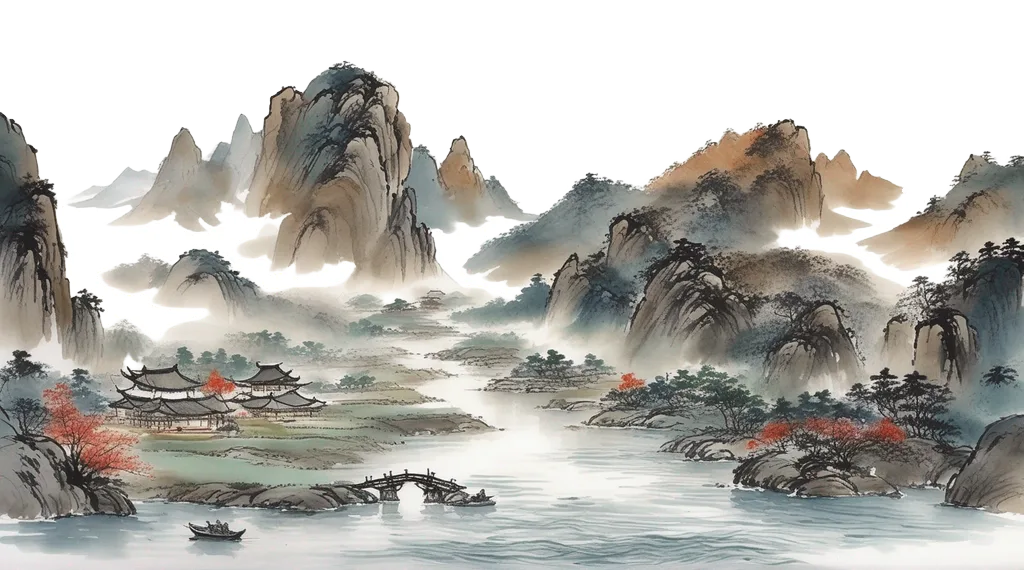
To lay some groundwork, the setting for the game is an island nation empire in a fictional world in which different lands have different types of magic and the supernatural. The magic of this land is cultivation, a way to develop your qi and perform superhuman martial arts. It’s an animist world, with spirits that represent everything from local natural phenomena to abstract concepts. It’s threatened by a Colonial Empire known as Aldermark, as well as local problems arising from bandits, blood sorcerers, corrupt officials and corrupted spirits. The technology level is about that of the 1940s.
The game space is about the size of a mid-sized European country, with train travel from one side to the other taking about 12 hours. It has five kingdoms and about forty towns, as well as the main city where most of the game takes place, Zhuwan. Each town has its own layout with houses, shops, taverns, churches, etc., and a full cast of usually about 50 NPCs. These NPCs are built out like a cast from a story, with each town centering around 5 or so primary NPCs who are treated like main characters, with other NPCs created in respect to their relationship to those five, or filled out to provide staff, families and so on. Each NPC has their own memory, personality and so on, with even some limited ability for their stories to progress even when no PC is around.
The different regions of the world also have different levels of assets and risk, assets being things like money, influence, and risks being things like corruption, crime, or spiritual unrest. There are also political actors, important NPCs like governors or monarchs who make decisions based on the state of the world at regular intervals; these are rolled to determine how successful they are, and impact assets and risks.
When a group of PCs venture undisguised into the wider world, as soon as they stop moving for at least a few minutes, an adventure starts to be built. This pulls in two hand-written adventure ideas, weighted towards the risks in the area, as well as recent activity in the area and details of the PCs, into an algorithm to synthesize into a general plot idea. Localizable elements are then extracted from the broad idea and run through processes to localize them. So for example, if the plot involved the kidnapping of an NPC, the system will find an in-game NPC suitable to be the one kidnapped. Then the final, localized story will be assembled into an outline and kicked off with an inciting incident that could be a villager running up to you for help, or a group of bandits that kick in the door of the tavern you’re drinking in.
The PCs could ignore the inciting incident, although that will have some consequence, or they can engage with it and play through the story, rolling stats, RPing with NPCs, investigating clues, fighting enemies in everything from small scuffles against bandits to battles against large, chimeric monsters with multiple body parts that can be individually attacked, with the ability to even clamber up them to deliver particularly potent attacks.
Throughout the adventure players accumulate fate and destiny. They accumulate fate whenever they ‘tempt fate’ by succeeding greatly or bragging, and fate twists the story in ways that make it more difficult for them. They accrue destiny through behaving honorably and battling through hardships, and they can spend it to alter the story, creating new details or threads for themselves or even for others. You could use destiny to say that a particular NPC is the angry ex of another PC, for example, and while the other PC would have to agree to that, there are incentives for doing so. This makes going through these adventures with others a lot more creative and collaborative experience than it usually would be.
At the end of the adventure, the effects of it are applied back to the world. Local NPCs will hear about the story, local risks and assets change, NPCs who were killed or arrested in the story are removed from the world, others might turn into ongoing villains with grudges against particular PCs and so on. And also, of course, PCs will gain rewards at the end of the adventure: maybe money or other valuable assets, maybe influence and renown, or some combination of the above.
So it’s obviously really hard to know from how something is designed how it will actually feel to play. Often systems require a fair bit of iteration to really shine, and this is all novel enough that there aren’t a lot of past learnings to lean on, and I’m just one person trying to do a thing. So I don’t want to overpromise, but I think it’s enough to give you an idea of the goal. A living, breathing, dynamic world in which you can go out and have exciting, collaborative and creative adventures with others, where your choices matter and ripple through the world. Where what happens and how is all driven within the fiction of the world, not by OOC relationships or simple maths. And if it comes together as I hope, there’s a real shot at creating that real feeling of transportation, of wonder.
I’ll go over some other aspects of the game now, briefly outlining how they work and why they work that way.
Martial Arts
Every PC is a martial artist who grows stronger through cultivation. That is, they acquire rare ingredients through spending money, influence or finding them, and distil these into pills which make them stronger. Certain activities, like sparring or getting a lesson from a master in a style, make this easier. There are twelve styles in total, broken up into four schools. Each style has nine unique abilities as well as a unique mechanic, for just over a hundred unique abilities. Characters can have multiple styles and switch between them mid-combat. While anyone can learn any style, to learn an ability from another school you have to plan and execute a stealth mission to steal a manual from that school. And if that goes badly, it could end with you being taken hostage for a while by another PC.
The combat system is simultaneous turn-based, with characters choosing who they want to attack, where they want to move and what abilities or tactics they want to use at the top of the turn, then those play out. Fights are had on rendered battlemaps, with exploitable environmental features like pits, explosive crates, toxic mushroom patches, elevation, cover and LOS blocking, and have several wuxia-unique features like the ability to leap into tree branches or run along walls.
Why: I’m quite fond of wuxia martial arts as a basis for RP combat since it combines a lot of the cool parts of physical fighting, the athleticism and mobility etc., with a lot of the cool parts of magic fighting, the creativity and flashiness. The multiple styles system also helps deal with combat progression problems: once your style hits level 9 you’ll move to leveling up new styles, while having more high-level styles is an advantage in combat because of the flexibility it gives you, it’s not an overwhelming one like just having flat better numbers. This provides meaningful progression that also doesn’t make joining the game later suck.
Romance
All PCs have qi dice. This is a special dice pool that builds up over time that you can choose to add to rolls in combat or in adventures, activities, etc., to give yourself a boost. Essentially, your character is channeling their qi into making a more superhuman effort at that thing. The number of faces on your qi dice is determined by your qi intensity. As you RP/flirt with other PCs, your chemistry with them builds. The higher the chemistry you have with a PC who’s around, the higher your qi intensity, with a bonus if you’re opposing or fighting the person you have chemistry with. If you hook up with someone the chemistry resets, although if it was reasonably high you’ll also gain some cultivation from it being consumed.
Why: Now why would I open myself up to all the hating that something like this will no doubt bring? Well, I’m generally of the belief that the most important thing in an online RPG is the relationships between the PCs, romantic or otherwise. But that the quality of these stories can be significantly degraded by the same convenience and comfort creep I mentioned before. The system forces complications into that, making decisions more complex than just ‘why not?’, particularly with elements like benefiting from flirting with your enemies more than your allies. It just makes things messier. It’s also useful for thematic reinforcement, since noble social-intrigue historic RP can easily be undercut by things being overly pornographic.
As it is, a character expressing attraction to another opens the character up to social risk if rejected, and this often has a heavy OOC bleed element. On the flip side, turning someone down also tends to carry a risk of the player taking it OOCly hard. The system reduces the risk to players OOCly of these interactions, since the RP is potentially just you trying to level up your qi intensity instead of you OOCly wanting to read some smut, and the rejection is potentially you wanting to protect your qi intensity rather than you OOCly not wanting to read someone else’s smut. The ambiguity gives people a safer space in which to RP these themes.
Progression
The main progression loop of the game revolves around energy. You gain energy over time, slightly faster when online, and scaled based on RP assessments to do with theme, etc. This energy can then be turned into money or used to do different types of activities. Money and influence, which are what’s awarded for many activities, can in turn be traded for cultivation resources. As well as Jianghu adventures, you can also use energy for delves, dungeon-crawling activities that you can do alone or with others. To create stealth missions to obtain manuals or other things. To host or attend high-society events, each of which in turn has support for several different types, from dances, to exhibition fights, to art shows. People can also gain influence through their outfits at events.
You start the game with two martial arts styles. The next one you get costs twice as much to level, and the one after that 2x the previous, and so on. While players play one character at a time, they have a shared family and family estate that carries over between characters, your next character being a child or cousin or the like who is inheriting the family estate in Zhuwan. Estates contain martial libraries so you don’t have to re-obtain manuals, and also re-learning a style a previous character of yours learned is much faster.
Why: The energy system rewards playing more often but not at a linear rate. Being online more often gives a slight boost, but more to the point gives you more shots at getting higher ratings for RP elements. But playing twice as much as someone wouldn’t give you twice as much energy. The goal is that there’s always a mechanical benefit to being online and RPing, but also that people with different playing availability aren’t on entirely different playing fields. By having a wide variety of ways to turn energy into cultivation, it helps people have a variety of things to do, lets people choose the things they enjoy to focus on and reduces the temptation to do things you dislike for min-max reasons.
The family estate allows people to carry forward a reasonable amount of previous work onto new characters, reducing the barriers to starting a new character. The rapidly increasing costs of adding new styles means it’s near impossible to master everything and creates a strong positive incentive for making a new character, because on a new character you’ll be able to start over with a new build. Especially since there is the intention to add new styles relatively regularly.
Launch Plans
The open alpha will start on the 19th and is expected to last between 1-3 months. Then there will be a beta, which is expected to last about 3 months, then the first iteration of the live game.
All iterations will be ICly consecutive and you can keep your character through all of them, but there will be timeskips of usually around 5 years between each one.
There will be some sort of power reset at the end of alpha; what it is and its size will be determined by what’s encountered during alpha. If there’s no big issues discoverd it’ll likly be pretty minor and people will keep most of what they gained in Alpha. There’s not expected to be a power reset at the end of beta, but there could be if any major problems occur during beta that would require it.
During alpha, certain features won’t be in effect or will function differently. The metaplot will be a smaller story than in later arcs. There won’t be arranged marriages, characters will self-join sects instead of being invited to them, and at launch the combat system won’t have the same level of autobattle or auto-balancing support. (It’s not worth training the model on the combat system to power this until I’m confident all the main bugs in combat are squashed.)
The general plan for the game is that it will run in a series of arcs, each with their own metaplot, with timeskips between each arc that allow for a soft reset.
The game has a dedicated Discord server that anyone is free to join and hang out in, whether they’re playing or not, accessible here: discord.gg/HPDuAjmwbz
Sincerely,
Nova.