
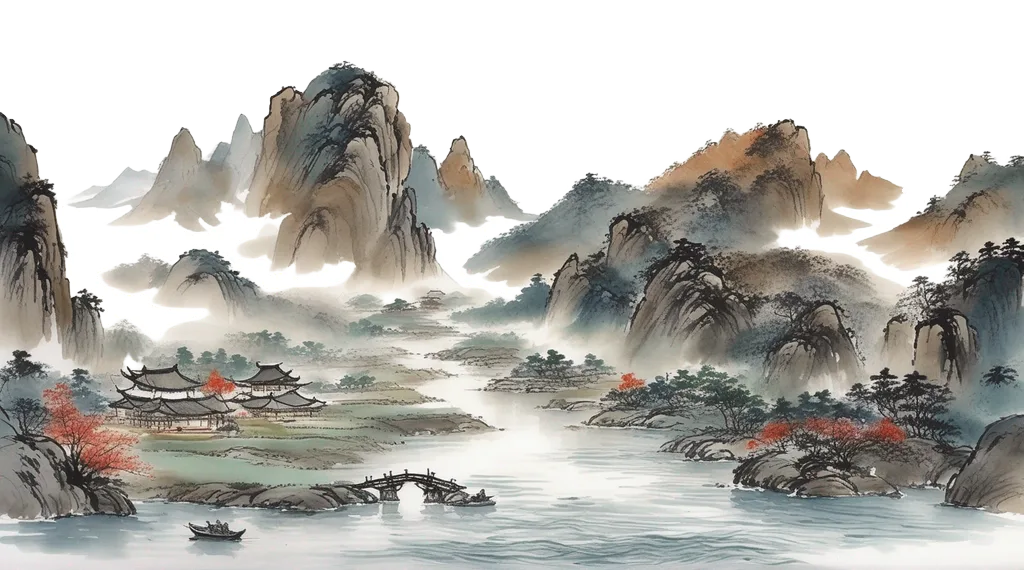
Romance of Five Kingdoms is a romantasy wuxia game set in the Àolǎng Empire, an island realm a little smaller than France, drawing on Chinese-influenced fantasy in the way that a typical Western fantasy draws on medieval Europe. It is not historical China. There is no Confucius, no Buddha, no Tang, Ming, or Qing dynasty. The gods are not borrowed; the dragons are not borrowed; the philosophy is not borrowed. Everything in this world is invented for this world. Please do not import real Chinese history, mythology, or religion into your roleplay. If something feels like it would be a reference, it almost certainly should not be.
The world sits at roughly a 1940s level of technology. Telegraph wires cross the rice terraces; the great port of Zhūwān has neon signs in classical calligraphy beside traditional teahouses; trains and gunboats exist and matter.
Honorifics
Honorifics are an optional courtesy that can carry a lot of conversational weight. The four short particles are Wei (the addressee is your senior), Xia (the addressee is your junior), Me (the addressee is your ally), and Di (the addressee is your honored rival). They combine: Weime is a senior ally, Xiadi is a junior rival, and so on. They shift sentence to sentence as the topic shifts. Speaking without one is neutral and unremarkable; using one is respectful, and a -di form is the polite way to disagree without disrespect. See help honorifics for the full table.
Bowing
It’s customary to bow to people upon greeting them, bowing deeper and longer conveys more respect.
Fashion
The technology level of the Empire is roughly 1940s, any fashion up to this point is acceptable, drawing from most any culture. While the most common garbs are robes, dresses and suits anything which doesn’t seem overtly modern is acceptable. It’s a fantasy setting, so outfits can also be more varied or elaborate or creative than they would have been historically. It’s also an era of refinement however, outfits that show copious amounts of skin or the like are considered in extremely poor taste.
Gender
The empire is gender-balanced. Women rule kingdoms, command armies, run merchant houses, and duel in the streets on equal footing with men. Sects, orders, and the imperial bureaucracy are all open to anyone. While sexism does exist, it’s more rare and repressed than open, similar to modern society.
Sexuality
Àolǎng Culture, particularly that of the higher classes is very concerned with dynasty and family. Gay marriage is not legal and marriages are usually arranged and inescapable unless one joins the Starlight Order. However, outside of this obligation, there’s very little concern with someone’s sexuality and lavender marriages are not uncommon.
Names
Names in Àolǎng are always given forename-first, regardless of which cultural register a name reads in. Yuèhé Lanaris is forename Yuèhé, house Lanaris. The empire is intentionally a cultural mix: not every name will sound Chinese, and that is canon. Ambassadors and certain noble appointees use a hyphenated <birthname>-<housename> form (for example, Sháo-Lanaris) to mark their formal role.
Class and cultivation
Cultivation, the refinement of qi into superhuman martial ability, is open only to those of noble blood. Commoners cannot cultivate; the rare exception is always quickly explained as a hidden noble bloodline rather than a true exception to the rule. This is not just flavour, it is class: cultivators heal faster, hit harder, age slower, and command rooms by walking into them. Your character’s relationship to cultivation tells everyone in the room where they stand. Cultivation is martial and herbal, not religious; cultivators are not monks, and the sects are not temples. Nobles being the only ones who can cultivate is generally seen as clear evidence of their superiority over the commoners and their right to rule. See help cultivation.
Drugs
Opium is a popular drug in the Empire, and tends to fluctuate between different levels of legal, illegal and decriminalized with no Kingdom finding a particularly successful strategy for dealing with it.
Legal Structures
Towns are ruled by a Magistrate, and regions by a governor. While there are sets of official laws these can be overridden by the respective official. As members of a royal house you likely will never be convicted of a crime, but if you bring enough dishonor to your house you may be quietly disappeared.
Honor
Honor is very important, both Honor of the family and of the individual. Being truthful, righteous, loyal, respectful, brave, and polite are all considered very important.
Spirits
The world is animist. Almost every river, mountain, threshold, hearth, and human concept has an associated spirit, and the greatest of them take the form of dragons. Spirits can be kind, indifferent, or malevolent according to their nature. Táimí, the Singing Forests, treats spirits as part of daily life; other kingdoms keep more of a wall between civic and spiritual life, but no one denies the spirits exist. Shrines on doorways and at street corners are not decoration; they are functional. See help spirits.
Magic
Beyond cultivation, the main form of magic is blood sorcery, powered by sacrifice. It is not inherently evil. A village witch sacrificing a chicken to ward a barn is doing blood sorcery; so is a self-immolating martyr saving a town. Most practitioners, however, are malicious, and cultivator blood is the most prized fuel of all. See help "blood sorcery".
The five kingdoms at a glance
- Sìshuǐ is the imperial heart, ruled by House Lanaris: cosmopolitan, water-themed, diplomatic.
- Táimí is the Singing Forests: animist, decentralised, every village a law unto itself, the most “different” daily-life of the five.
- Jīnjiǎ is martial and hierarchical: ranks, duels, brass and ox-blood.
- Qiānjīn is the trader kingdom: loud, plural, fashion-forward, status by wealth not birth.
- Tōngzhì is the scholar kingdom: quiet bureaucrats, libraries, and one of the empire’s most dangerous intelligence apparatuses behind the spectacles.
Read help kingdoms for the full sketches, and pick the one that fits your character rather than defaulting to the imperial one.
The political moment
The empire is under pressure. The Commonwealth of Aldermark, the colonial Western power, supplies the empire’s imported technology and is steadily extracting concessions through unequal treaties anchored in Zhūwān harbour. Shirogane, a long-standing rival civilization across the water, is a separate strategic problem.
Sects, schools, and orders
These are not interchangeable.
- Schools teach martial styles. The four great schools are Ember Fist, Veiled Grace, Mirrored Tempest, and Radiant Chorus.
- Sects are voluntary associations with shared agendas, philosophies, or trades. Some are public, some hidden, some criminal.
- Orders like the Starlight Order are monastic, requiring renunciation of family and rank. Joining one is a permanent identity shift.
See help sects and help "the starlight order".